

At the top of the hill overlooking the village stands the church, dedicated to Saint Peter and Saint Paul with St Edmund, of flint with stone dressings, with a tall embattled tower nearly 100ft high with five bells, and a clock. The church is probably on the same site as the church of St. Ethelbert referred to by Bishop Theodred of London, who revived Christianity in East Anglia after the Danish invasion of the ninth century. In his will he declares: “I grant the estates at Horham and at Athelington to God’s community at St. Ethelbert’s Church at Hoxne”.
In 1086 the Domesday Book recorded that “in this manor (Hoxne) there is a church, the seat of the bishopric”. From very early times the bishops responsible for East Anglia had a palace where they held, and at that time the seat of the bishopric was quite literally - where the bishop sat. The Hoxne Palace was very probably on the site of Hoxne Hall.
It is difficult to say when a monastery was built in Hoxne. Redstone, the Suffolk historian, speaks of a small tenth century Benedictine monastery being built close to the chapel which housed the body of St Edmund for some 30 years immediately after his martyrdom (870) and prior to being taken to Bury St Edmunds. We do know that for some four or five centuries there was a small Benedictine priory in Hoxne at what is now Abbey Farm and this was an outpost of Norwich Abbey (now the cathedral).
An early mention of the change in the dedication of Hoxne parish church, comes in the Charter of Norwich Cathedral (1119) in which Bishop Herbert de Losinga gave “the church of Saint Peter at Hoxne with the Chapel of Saint Edmund” to the cathedral.
Although parts of the church building are earlier, most of the church is in the perpendicular style dating it between 1350 and 1500. The tower, which Pevsner describes as “one of the grandest West towers in this part of Suffolk”, was built by the second Duke of Suffolk, John de la Pole, in 1450 with the south porch being added in the same year.
The chancel was rebuilt in 1853 following renovations to the tower in 1847 and the chancel was restored in 1879 when the choir stalls, nave pews, lectern and pulpit were also installed. More recently, extensive renovations were carried out to the church during the 1950s and 1960s with the re-roofing of the north aisle and chapel and repairs to the stonework and glazing in other parts of the building. The south porch received particular attention at this time. The tower was repaired - and its Victorian corner pinnacles removed - in 1972. Restoration work continues with extensive repairs being carried out to the north wall during 1980. Exterior and interior work to reduce the levels of damp in the north wall were completed in 2017.
H. Munro Cautley in his book Suffolk Churches published in 1937 writes: “In the middle of the cornice on the south side painted angels remain, with black and white barber’s pole ornament above and the top member having folded red ribbon showing white reverse”. Very sadly, these disappeared in the extensive roof restoration carried out in the late 1940s and early 1950s.
The Story of St Edmund, King and Martyr
All we know about Edmund from contemporary sources is from the Anglo Saxon Chronicle (written around 890 AD), Asser’s “Life of King Alfred” (c 893 AD) and from coins minted during and after his reign.
The Chronicle simply says:
"Her rad se here ofer Mierce innan East Engle and wiñt setl namon. æt Đeodforda. And þy wint' Eadmund cying him wiþ feaht. and þa Deniscan sige naman þone cyning ofslogon. and þæt lond all ge eodon."
“Here the army rode across Mercia into East Anglia, and took winter-quarters at Thetford; and that winter King Edmund fought against them, and the Danish took the victory, and killed the king and conquered all that land”.
But Edmund must have been a remarkable king. Within thirty years of his death the very Vikings who killed him were venerating him as a saint, minting silver pennies with the inscription “SCE EADMUND REX” “St Edmund the King”.

In about 986, the French saint, Abbo of Fleury, wrote the story of St Edmund’s martyrdom for the monks of Ramsey Abbey. Abbo recorded that St Dunstan, who was Archbishop of Canterbury from 959 to 988, was his source and that Dunstan had heard the story of the martyrdom, many years before in the presence of King Æthelstan (c894-939), from an old man who swore an oath that he had been Edmund's sword-bearer. Abbo records that Edmund’s captors pressed him to renounce Christianity and when he refused they bound him to an oak tree on the hill above the stream and poured arrows into his body until he died. His head was struck off and thrown into the woods in the belief that this would prevent his followers giving him Christian burial.
When the Danes had gone the king’s followers recovered the body and searched the thicket for the head. Some time later, the story goes, one of the searchers heard a cry: “Here, here”, and he found the King’s head between the paws of a great grey wolf, who gave it up “without fierceness”.
The body was buried nearby and a wooden chapel built over the spot. The body remained there for 33 years until its removal to Boedericsworth (Bury St Edmunds) where the magnificent Abbey was subsequently built.
Abbo records that this took place at a “villa” called Haegilisdun where the martyrdom took place. The tradition that the martyrdom took place at Hoxne was first recorded in the Charter of Norwich Cathedral Priory by Bishop Herbert de Losinga in 1101 and was unchallenged for many centuries, although some modern scholars have suggested a number of alternative sites.
According to another later legend the King was hiding at Hoxne under a wooden bridge over the stream now known as Goldbrook when a newly-married couple crossing the bridge saw the glint of his golden spurs and betrayed him to the searching Danes. The story is that Edmund pronounced a curse upon any who might cross the bridge to get married, and even today, over a thousand years later, some brides will not cross the bridge on their wedding day.
By 900, Edmund was regarded as a saint and a Benedictine cell was established at Hoxne. Various sources then speak of a chapel of Saint Edmund at Hoxne. Indeed it seems that there were two chapels: one built where he died and the other where his head was found. This latter chapel became the site of the later Benedictine priory which is now Abbey Farm. Only some of the outer walls of the priory remain.
In Hoxne a great oak stood for 1,000 years until (extract from the Bury Post, October 11, 1848): “St Edmund’s oak at Hoxne, a remarkable tree and full of foliage, was entirely demolished on 11 September”. It appears that the tree fell suddenly on a fine, still morning. The trunk was 20 feet in circumference and the spread more than 84 feet. When the trunk was cut up what was thought to be an old arrow head was found buried deep in the wood some five feet from the base. Today, a stone cross marks the spot bearing this inscription: “St Edmund the Martyr A.D. 870. Oak tree fell August 1848 by its own weight”. Presumably it was the fall of the tree in August which necessitated its final “demolition” on 11 September. The reference to AD 870 was based on the old mediaeval calendar. In our modern calendar the year was AD 869.
A guide to the church
The font
Entering by the Porch at the South doorway, we notice first the font where Christians have been baptised into the faith of Christ for many centuries. Of traditional East Anglian stone it has an octagonal bowl with four of the sides sculptured with the emblems of the four Evangelists (Matthew, Mark, Luke and John), and the other four with angels bearing shields of arms. Those on the north and west faces bear two keys and two crossed swords, emblems of Saints Peter and Paul to whom the church is dedicated.
The east face has the arms of Bishop Lyhart of Norwich (1446 to 1472), who often resided at his palace at Hoxne, the site of which was probably the same as that of Hoxne Hall, latterly called Oakley Park, which was demolished in 1923-24. Bishop Lyhart died at his palace on Whit Sunday, 1472. It was he who built the Hoxne Vicarage which still stands beside the church.
The south face carries the arms of John de la Pole, second Duke of Suffolk, and his wife Elizabeth Plantagenet (sister of Edward IV) who married in 1460. This carving must have been made after that date, but before 1472, for in that year John de la Pole was created Knight of the Garter, of which there is no sign on the shield. His ancestor, Michael de la Pole, Earl of Suffolk, died in nearby Wingfield Castle (1415), as did succeeding members of the family, to whom there are memorials in Wingfield Church.
Had the course of history run differently, the house of de la Pole might have taken the throne of England, for the Duke’s son John was at one time named by his uncle Richard III as next heir to the crown.
The font bowl was supported by angels and other figures, but these have been much mutilated, probably by William Dowsing, the Cromwellian employed during the Commonwealth “for the defacing, demolishing and taking away of all images, altars, or tables turned altarwise, crucifixes, superstitious pictures, monuments and reliques of idolatry, out of churches and chapels”. Hardly a church in Suffolk escaped his vandalism, and being a diligent diarist he recorded his visit to Hoxne on August 30, 1644: “Two stone crosses on Church and Chancel. Peter with his fish, and a cross in glass windows and four superstitious ones. The Virgin Mary with Christ in her arms and cherubims wings on the font. Many more were broken down afore”.
Perhaps this was when the Bostock brass (now on the south wall under the window) was thrown into a nearby pond, to be found comparatively recently by Claude Hawes. The two pieces were restored and replaced in the church in 1950 largely due to the efforts and enthusiasm of Mr Kemp and Major H.P. Raven. The inscription reads: Pray for the soules of Thomas Bostock, Maude his wife, dyed St Edmunds day last past 1508.
The font cover was given in memory of his wife by Sir Frederick Bridge, who was organist at Westminster Abbey. He married his bride, Constance Ellen Moore of Elm House, Hoxne, in Hoxne church on April 3, 1872. She was buried in Hoxne church in 1879, having already buried at least three of her children. The second window from the main door is in memory of her mother and her children.
Memorial to Sir Edward Kerrison
On the south wall also is a fine carved memorial in Caen stone to General Sir Edward Kerrison, who as a Colonel, fought in the Battle of Waterloo. He was MP for Eye for 28 years (1824-52) and died March 9, 1853.
His son Sir Edward Clarence Kerrison (1821-86), also MP for the Borough of Eye and later for East Suffolk, president of the Royal Agricultural Society, founder of Framlingham College, and a great benefactor of the village, is commemorated on the same memorial. In 1880 he gave Hoxne its village hall.
Wall paintings from the 14th century
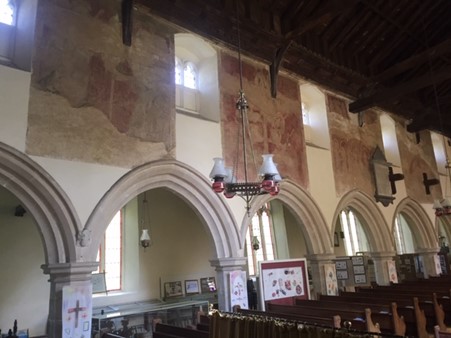
On the north wall of the nave and above the six rather low arches are the Wall Paintings (1390-1400) rediscovered in 1926 and then restored by the late Professor E.W. Tristram. They represent:
- Saint Christopher bearing the Holy Child on his shoulder and holding his staff which grew into a tree, showing the river bank, hermit and hermitage.
- The Seven Deadly Sins portrayed as a tree, with the figure of Pride at its apex, and springing from the trunk six dragons in whose mouths are allegorical figures representing the other vices.
- The Seven Corporal Acts of Mercy: clothing the naked; giving drink to the thirsty; visiting the imprisoned; feeding the hungry; housing the homeless; visiting the sick; and burying the dead.
- The Last Judgement, very indistinct between the fourth and fifth windows, is arranged in a semi-circle formed by the arch of a rainbow, with the figure of Christ seated at the top, and faintly visible at either side angels holding symbols of the Passion.
Traces of paintings on the south wall were also recorded in the 19th century but no evidence of these now remains.
Crucifix from France
The war memorial was erected in 1921 to the design of Mr Fellowes Prynne FRIBA and subsequently extended to include the fallen of the Second World War. It incorporates a crucifix found on a battlefield in France and was brought back to Hoxne by Mr T. Wells who had escaped from being a prisoner of war in World War One.
The oak hymn boards were carved and given in 1900 by Mr Edward Aldred, a craftsman of Hoxne.
Recalling the loss of H.M.S. Captain
Memorial tablets commemorate the sad loss of H.M.S. Captain, which capsized in a storm in the Bay of Biscay on the night of September 6, 1870, with the loss of all but 18 of her 600 crew. HMS Captain was an experimental ship as she carried her guns in turrets, (as opposed to in broadside batteries) with a full, sailing rig and steam power. She was commanded by Captain Burgoyne VC, son-in-law of Admiral Wake Walker, of the Depperhaugh, Hoxne. Two flags from the ship, recovered from the sea after the disaster, hung for some years above the tablets until, because of their age and fragility, they were cremated and the ashes scattered in the sea where the Captain went down. A window by the pulpit is in memory of Captain Burgoyne. The University of Wolverhampton is leading an international, multi-institutional effort to find the wreck of HMS Captain. Information about the project is available at: https://findthecaptain.co.uk.
Many memorials
On the floor of the nave and sanctuary are memorials to the Thruston family who came to live at Abbey Farm soon after the dissolution of the monasteries.
Above the south doorway of the chancel is a memorial monument of black marble with Latin inscription to the son of Nathaniel and Elizabeth Thruston who was buried on September 3, 1658.
There are many floor memorials including those to John and Samuel Leman, churchwardens at Hoxne for many years, and to the Rev. Nathaniel Frith, Vicar of Hoxne for 36 years, and his wife Frances.
Many other memorials were recorded in the past which are now lost.
The altar
A new altar was built in 1907, through the gift of Mr and Mrs S.
Hill-Wood, with the original “mensa” altar slab of Purbeck marble, with five consecration crosses, built into the new oak table. This slab had lain on the floor of the sanctuary for many years.
The panelled oak reredos contains portions of an old screen and was placed in the church in 1907, the gift of Mrs F. Ffrench of The Depperhaugh. The newer parts of the reredos are the work of a Hoxne craftsman, Mr Brown.
The memorial to Sir Thomas Maynard Hesilrige and his wife, over the door leading to the clergy vestry, is the work of Sir Francis Chantrey one of the great sculptors of the last century. Sir Thomas was the last member of the Maynard family to live at Hoxne Hall, the hall and estate together with the Cornwallis Estate at Brome subsequently being bought by Matthias Kerrison of Bungay.
The St Edmund Chapel

At the East end of the North Aisle was the former Lady Chapel of Hoxne Church. When Edward Steele, an antiquarian from Hertfordshire, visited Hoxne church in 1712 he wrote of this chapel being separated from the rest of the church by an “Ancient Skreen” and says that it has been appropriated to the sole use of the “the Family of Barkers”. The Barkers were an old family dating back to at least the 14th century and had their home at Chickering. Steele records only two Barker gravestones in the chapel - Mr Bennett Barker, twice Alderman of Bury St Edmunds who died in 1632 and Thomas Barker who died in 1626 - but an earlier writer also records a brass memorial to Robert Barker recording that he built the Lady Chapel.
This chapel now houses the large monument of Thomas Maynard, by the famous sculptor Charles Stanley, which was erected in 1742 and occupies the whole of the east wall of the chapel. Thomas Maynard founded and endowed a school for Hoxne and his endowment continues to help local students through a charitable trust.

We are currently in the process of turning this chapel into a chapel dedicated to St Edmund with the mediaeval pews restored, a new altar and votive candle stand and a beautiful icon very generously donated by a local parishioner. We have also re-erected and restored the lovely St Edmund screen which was originally the tower screen, as the entrance to the chapel. This beautifully carved screen was donated by the Kerrison family in 1879 and designed by the architect JK Colling. It includes a carving of the martyrdom by the famous Victorian sculptor and woodworker, Harry Hems.
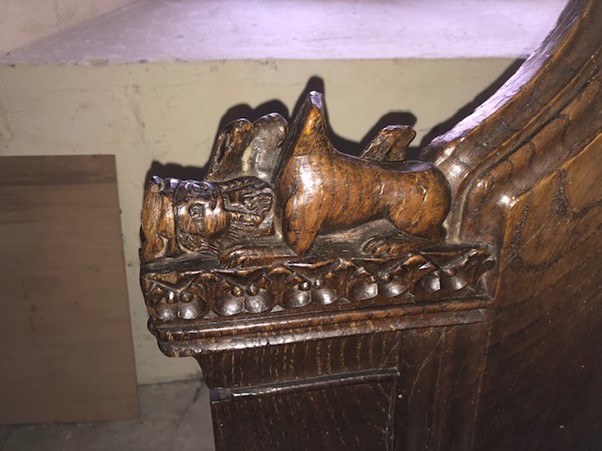
Carving of wolf and St Edmund’s head
The pews in the St Edmund chapel have mediaeval bench ends. The carvings are sadly damaged but the one representing the wolf holding St Edmund’s head can be clearly identified.
The organ
When the Kerrison family bought the Maynard Estates they placed an organ in front of the Maynard memorial. The organ, originally a barrel organ, was given to Hoxne Church by General Sir Edward Kerrison in 1836. It was later converted into a single manual organ and then, in 1906 rebuilt as it is today, as a memorial to the Hon. Walter Bateman Hanbury, the grandson of General Sir Edward Kerrison. In more recent years, the organ was moved to the foot of the tower. As part of our plans to restore the bells and reopen the west door of the church, the organ will soon be moving to the north aisle where we hope it will be better seen and heard.
Windows with dedications
The church has seven stained glass windows dating from 1855 to 1876 – five dedicated to people with close links to the parish. The most significant is the east window signed by E Baillee of London (1855) and commissioned by Sir Edward Kerrison. Lt John Hatton Hodgson, who died aged 22 on 17th February 1868 is remembered in the window on the right of the sanctuary and the Revd John Hodgson (Vicar of Hoxne for 25 years) who died on 20th October that year, in the next. St Peter and St Paul are depicted in the third window; while the memory of Charles Sinclair Walker (1870) and that of Hugh Burgoyne, master of HMS Captain, are enshrined in the fourth, probably created by Clayton and Bell. The final window on the south wall is by Heaton, Butler and Bayne of London, depicting angels as a memorial to Catherine Moore, of Elm House, Hoxne. The west wall of the north aisle features the crossed keys of St Peter, the crossed swords of St Paul and the St Edmund crown.
Church ‘treasure’ chest
One of the treasures of the church is the very large 14th century iron-bound elm chest with seven locks, standing at the west end. It recalls the time when the country was plagued by moneylenders. To counter their activities many villages set up chests in their churches to contain money which was loaned without interest on the security of a pledge or the word of sureties. The keys were held by a number of trustees - seven in the case of Hoxne. The chest was once almost lost to Hoxne. The then vicar had unwisely given permission for it to be removed to Worlingworth for restoration, and it was not until 73 years later (1900) that it was returned. Eight men were required to move the chest back into the church.
The church safe in the vestry was an ancient silver chest from Hoxne Hall, given to the church in 1931 by Mr A.J. Bland (churchwarden) of Elm House as a fire-proof safe for church documents.
The bells
At one time six bells hung in Hoxne Church tower but today there are only five. Old churchwardens’ accounts speak of a bell being sold and the money used for repairs and seating.

Within the tower of the church, hanging from an original Tudor oak bellframe which is thought to date from around 1499, are five bells. The state of the bellframe is such that that have not been rung for at least 70 years and it is thought that they may last have been rung to celebrate victory in 1945. The bells are as follows:
- The first bell is inscribed “John Darbie made me” and is dated 1676 and has the letters E.W.A.G.J.H.S.L
- The second is inscribed “Omnis Sonus laudet Dominum” (“Every sound praises the Lord”) and dates from 1655 inscribed J.B. The arms of the local Thruston family are inscribed on the bell.
- The third is inscribed + John Goldsmith fecit 1711 Gabriel J.L.R.W.C.W.T.P. Raven suggests that this was “almost certainly” recast from an earlier bell which was noted as having been inscribed “Hac in Conclave Gabriel Nunc Pange Suave” (“Now sing sweetly in this chamber, Gabriel”).
- The fourth is inscribed “Orate pro aia Ricardi Smith” and “Nos Thome Meritis Mereamur Gaudia Lucis” (“Pray for the soul of Richard Smith” and “By the merits of Thomas may we deserve the joys of light”. In a manuscript we have by the Revd JJ Raven author of “The Church Bells of Suffolk” and Rural Dean of Hoxne in 1900, he suggests that this Thomas was a reference to Thomas Becket. At each stop is the sign of the Brasier family, bellfounders of Norwich, and probably refers to Robert Brasier fl 1391-1429. Brasier was Mayor of Norwich in 1410.
- The fifth is inscribed “Fac Margareta Nobis Hec Munera Leta” (“Make O Margaret these offices delightful to us”)
The bells are currently silent owing to the condition of the medieval oak frame on which they hang but we hope soon to restore them.
The South Porch has the restored features of a king and queen on the corbels of the inner door way. The massive tower, some 90 feet high, was once adorned with pinnacles. The clock, familiarly known as ‘Jubilee’, was subscribed for by the village and put up in 1887 on the occasion of Queen Victoria’s Jubilee. The west doorway is notable for the decoration of mitres, crowns and plain shields in the hollow of the moulding. The statues are of St Peter and St Paul.
And so to the lychgate made by Herbert and Audrey Leggett and consecrated by the Bishop in 1954.
In the churchyard once stood the Guildhall - in 1723 a house for several poor families – which was sold in 1838 and later demolished. In its place Oakley Terrace was erected as alms houses by General Sir Edward Kerrison.
The church registers date back to 1548.
Contents of this Guide have been compiled by a number of contributors over the years – principally the late Mrs Nora Coleman.
Drawings by Edward Chester.
Page last updated: Monday, 18th August 2025


