

Christianity first arrived in England during the Roman Empire. English bishops attended the Council of Arles which was called by the Emperor Constantine as the first representative meeting of Christian bishops in the Western Roman Empire in 314 AD. And there may well have been Christians in Hoxne around that time came too.
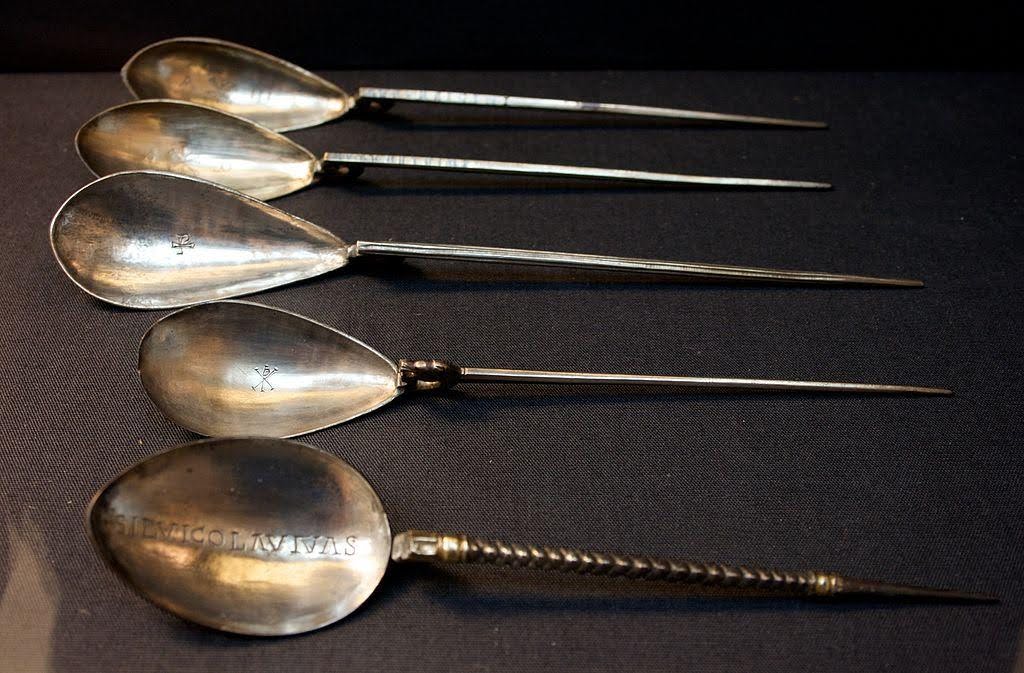
Not only was the Hoxne hoard the largest hoard of Roman silver and gold coins ever discovered in Britain, but it also included spoons, many of which are decorated with the Christian XP Chi-Rho symbol. Some also have the Greek letters alpha and omega (a reference to Christ who is described as the alpha and omega in the Book of Revelation).
As well as these Christian symbols, many also have their owner’s name on, sometimes also wishing them a long life. All together there are eight different names: Aurelius Ursicinus (the most frequent name), Datianus, Euherius, Faustinus, Peregrinus, Quintus, Sanctus, and Silvicola. Who were these people and were one or more of them involved in hiding the hoard? Sadly we simply don’t know. Only one inscription (vivas in deo or “may you live in God”) is obviously Christian but there are no definitely non-Christian inscriptions, so this suggests that the hoard was indeed owned by Christians. The spoons may have been christening presents or used in Communion services.
What we do know is that the coins date the hoard to some time soon after 407AD so there were almost certainly Christians in Hoxne over 1600 years ago.
We don’t know where Aurelius Ursicinius lived and worshipped and nor do we know when the first church was built at Hoxne but we do know that the first church here may not have been dedicated to St Peter and St Paul or to St Edmund. In his will Bishop Theodred of London, who died in the 950s, writes “I grant the estates at Horham and at Athelington to God’s community at St. Ethelbert’s Church at Hoxne”. Now it’s possible that there’s some confusion here because St Æthelberht – now more commonly known as St Ethelbert – was another Anglo Saxon king who was also seen as a saint and martyr after he was murdered on the orders of Offa of Mercia on 20 May 794 AD. Did Theodred confuse St Ethelbert with St Edmund? We don’t know but there are a number of churches in England dedicated to St Ethelbert and he remains the joint patron of the cathedral at Hereford which is near where he died.
Our church was also mentioned in the Domesday Book, which was written in 1086, and which says “in this manor (Hoxne) there is a church, the seat of the Bishopric” but sadly there is no reference to the church’s dedication at the time. What we do know is that by 1119, in the Charter of Norwich Cathedral, Bishop Herbert de Losinga gave “the church of Saint Peter at Hoxne with the Chapel of Saint Edmund” to the cathedral.
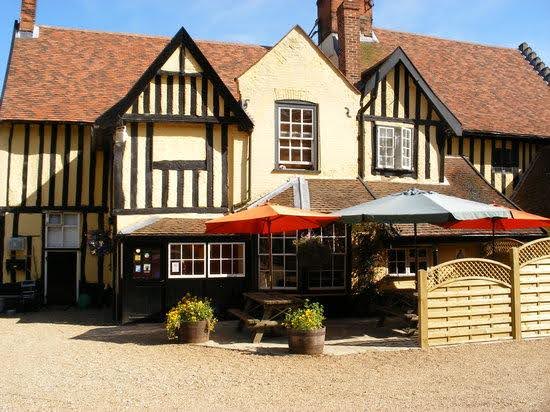
Today “the seat of a bishop” means a cathedral – the word actually comes from the Latin word cathedra which is a Bishop’s throne – but at that time the seat of the Bishopric was simply wherever the Bishop stayed and so he probably had a palace here, though not what we would now call a cathedral. The Hoxne Palace may have been on the site of Hoxne Hall or Oakley Park where the Kerrisons and earlier the Maynard families lived and which was sadly demolished in the 1920s. And right up until the Reformation the Bishop Of Norwich kept a lodge here which is now an excellent pub, The Swan, built around 1480.
Today, although parts of the church building may be earlier, most of the church is in the perpendicular style and so dates between 1350 and the end of the 15th century. The tower was built by the second Duke of Suffolk, John de la Pole, in 1450 with the south porch being added in the same year. The chancel was rebuilt in 1853 following renovations to the tower in 1847 and many renovations and restorations have taken place over the years.
For centuries then, the people of Hoxne have worshipped in this church. We don’t know their names but we do have a list of vicars going back over 700 years. They were:
1310 Richard Frebern
1320 Peter de Tatyington, Peter Osberne.
1350 John Elys de Hoxne
1360 Peter de Hoo
1360 Henry son of John de Lydgate
1367 John Doget
1370 John Martyn
1384 John Anty
1387 William Hodyngton
1388 Gilbert de Archais
1389 Simon de Becham
1396 John Barton
1406 Thomas Stebbying
1414 Robert Tymworth
1416 Walter Wylmot
1420 John Jonysson
1423 Simon Herryys de Hoxne
1443 Peter Howylyn
1461 Robert Barker
1475 Richard Halle
1495 Thomas Audeley
1528 Thomas Bacon
1530 Thomas Bacon
1554 James Sheparde
1572 William Rushbrooke
1585 Lewis Owen
1594 Thomas Sayer
1645 Oliver Hall
1646 Edward Willan
1690 Francis Hutchinson
1706 Nathaniel Frith
1743 William Gould
1772 William Reeve
1786 Charloss Ray
1790 Charles Brooke
1794 George Clarke Doughty
1832 James Cox
1843 John Hodgson
1869 Edward Heneage Paget
1883 Henry Murray Downton
1909 Westgarth Duval
1927 Claude de la Bere
1928 James Kirkman Wood
1946 William Groom
1949 James Gilchrist
1955 Guy Moss
1962 Claude Syms Scott
1971 Eric Sherlock
1975 Jack William Draper
1985 Anthony R. Lowe
2006 David Finch
2008 Susan Loxton
2013 Michael Womack (Rector)
2020 Eleanor Goodison (Priest in Charge)
And the church was not the only place where God was worshipped in Hoxne. There was also a Benedictine priory which was founded around 950AD with chapels at the supposed site of St Edmund’s martyrdom and of his first burial. The chapel was given to Norwich cathedral by Bishop Herbert de Losinga in 1101 and the priory was rebuilt by Maurice of Windsor and his wife Egidia by 1130. The priory may originally have shared the site of the church and may have moved around 1226 to be near the chapel marking the traditional burial site of St Edmund. There it continued for over 300 years until it was dissolved in 1538. The site of the priory is now Abbey Farm but nothing remains of the old priory buildings above ground except for the flint wall which runs beside the road. The priory was always small and the prior was probably accompanied by only seven or eight other monks but they provided a school for the children of the village.
There was also a Baptist Chapel in Cross Street which is now a private house.
So for many centuries people on Hoxne have met to worship God and, although language and liturgy have changed over the years, we still meet to hear His word and to share His love. The thought of that communion of saints continues to inspire us and, if Aurelius Ursicinius were to drop in on our service of Holy Communion on a Sunday morning, he might not understand our language but he would know what we were doing.
Page last updated: Thursday, 26th September 2024


